- Obstacles must be clearly numbered.
- There should be a minimum of 10 feet between obstacles but 15 feet to 18 feet is preferred.
- The course should be smooth, not choppy, or sharp.
- Don’t begin or end the course with contact obstacles or weave poles.
- Avoid two contact obstacles in a row.
- Put the Pause Box/Table near midpoint of the course.
- Don’t create handler restrictions – the handler should be able to work from either side of the obstacle. Design the course using graph paper.
- Design the course so it’s easy for the judge to see all obstacles and contacts with minimum movement.
- Judges should be aware of any holes, bumps, trees, poles, etc., that would possibly be hazardous.
The handler and the dog should stand 5 feet to 8 feet from the first obstacle. There should be at least 5 to 8 feet from the last obstacles. Start and Finish may use the same jump for the same “line”.
A dog’s time starts whenever any part of the dog crosses the start line, defined as the plane of the first obstacle. A dog’s time stops whenever any part of the dog crosses the finish line in the correct direction when the dog is in the closing sequence. The finish line is defined as the plane of the last obstacle. The closing sequence is defined by the completion of the second to last obstacle on the way to the finish obstacle. The dog shall be on leash when exiting the ring and not be allowed to run loose “off leash” around the show grounds.
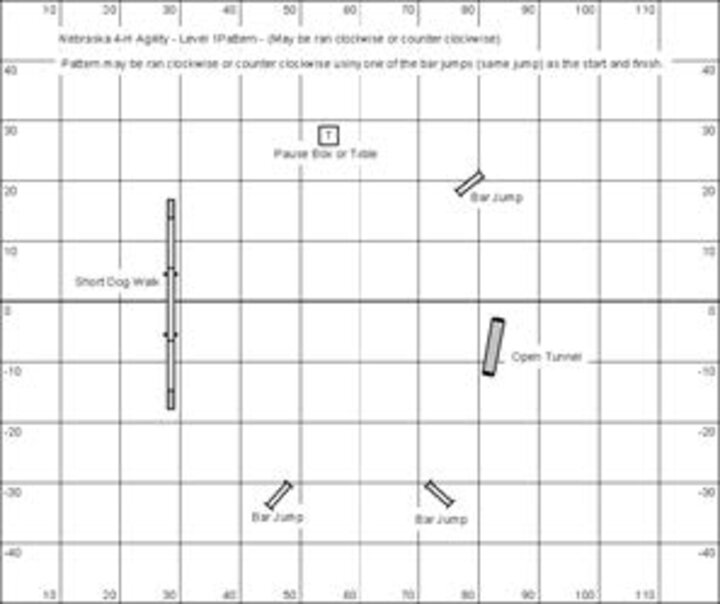
Level 1 course may be run either direction (clockwise or counterclockwise). Agility numbers are needed to number the obstacle order on how to run the course sequence, clockwise or counterclockwise.