Ring
The suggested ring size for an indoor show is 35 feet wide and 50 feet long for all obedience classes. The floor shall have a surface or covering that provides firm footing for the largest dogs. Rubber or similar non-slip material must be laid for the take-off and landing at all jumps unless the surface, in the judge’s opinion, does not require it.
At an outdoor show or trail, the suggested ring size is 40 feet wide and 50 feet long. The ground must be clean and level, and the grass, if any, shall be cut very short. For the Graduate Novice and Open classes, the superintendent is responsible for providing an appropriate place, approved by the judge, for the handlers to go to be completely out of sight of their dogs. If inclement weather at an outdoor trial necessitates the judging of obedience under shelter, the ring size requirements should be adjusted.
Use of Leash
All handlers should use a 6-foot leash. Keep all dogs on leash (except when in the obedience ring as directed by the judge for off leash work). Leashes should stay attached to the dog’s collar in sit and down exercises.
Collars
Dogs may be shown in either a chain collar, martingale, or buckle collar (like those pictured). Dogs in the obedience ring must wear properly fitted collars approved by the judge. Collars with prongs or spikes on the inside or outside, electronic collars, special training collars or collars that are either too tight or so large as to hang down unreasonably in front of the dog are not permitted. Nothing shall be hanging from the collars.
Images of the collars/leads can be found in Appendix B.
Misbehavior
Any discipline by the handler in the ring, any display of fear or nervousness by the dog, any uncontrolled behavior of the dog such as snapping, barking, or running away from its handler, whether it occurs during an exercise, between exercises, or before or after judging must be penalizedaccording to the seriousness of the misbehavior. The judge may expel or excuse any dog from further competition for these and other misbehaviors. Overly aggressive dogs will be expelled or excused and may be asked to leave the dog show facility.
Commands and Signals
Whenever a command or signal is mentioned in these guidelines, the handler may give either a signal voice command or signal. Any extra commands or signals must be penalized. When the guidelines specify “command and/or signal,” the handler may give either one or the other or both command and signal simultaneously. When a signal is permitted and given, it must be a single gesture with one arm and hand only. The arm must immediately be returned to a natural position. Delay in following a judge’s order to give a command or signal must be penalized unless the delay is directed by the judge because of some distraction or interference.
For example, the signal for downing a dog may be given either with the arm raised or with a downswing of the arm. Any pause in holding the arm upright followed by a downswing of the arm will be considered an additional signal.
Handler’s loud commands create a poor impression of obedience and should be avoided. Shouting is not necessary even in a noisy place if the dog is properly trained to respond to a normal tone of voice. Commands that are, in the judge’s opinion, excessively loud will be penalized.
Heel Position
The heel position, as used in these guidelines, means that the dog shall be straight in line with the direction in which the handler is facing, at the handler’s left side and as close as practical to the handler’s left leg without crowding – the handler needs freedom of motion at all times, whether the dog is sitting, standing, or moving at heel. The area from the dog’s head to shoulder shall be in line with the handler’s left hip.
Heel on Leash
The principal feature of this exercise is the ability of the dog and handler to work as a team. The handler shall enter the ring with the dog on a loose leash and shall stand with the dog sitting in the heel position until the judge asks if the handler is ready and then gives the order, “Forward.” The handler may give the command or signal to Heel and shall start walking briskly and in a natural manner with the dog on loose leash. The dog shall walk close to the left side of the handler without crowding, permitting the handler freedom of motion at all times. At each order to “Halt” the handler will stop, and the dog shall sit straight and in the Heel position without command or signal and shall not move until the handler again moves forward on order from the judge. It is permissible after each Halt for the handler to give the command or signal to Heel before moving again.
At the handler’s option, the leash may be held in either hand or in both hands, provided the hands are in a natural position. However, the handler and dog will be penalized if, in the judge’s opinion, the leash is used to signal or give assistance to the dog. Any tightening or jerking of the leash or any act, signal, or command which, in the judge’s opinion, gives the dog assistance shall be penalized.
The judge will give the orders: “Forward, Halt, Right Turn, About Turn, Slow, Normal, and Fast” which signify that both the handler and dog change to a noticeably different pace. These orders may be given in any sequence and may be repeated if necessary. In executing the About Turn, the handler will do a Right About Turn in all cases. The judge will say, “Exercise finished,” after the heeling and then, “Are you ready?” before starting the Figure 8.
The judge will order the handler to execute the Figure 8. On this order, the handler may give the command or signal to Heel and, with the dog in the heel position, shall walk around and between two stewards or cones about 8 feet apart. If there is only one steward, the contestant shall walk around and between the judge and the steward. The Figure 8 in the Pre-Beginning Novice, Beginning Novice and Novice classes shall be done on leash only. The handler may choose to go in either direction. There will not be an About Turn in the Figure 8, but the handler and dog shall complete the Figure 8 twice, with at least one Halt during and another Halt at the end of the exercise.
Stand for Examination
The judge will give the order to “Stand for Examination.” The handler, without further order from the judge, will stand or pose the dog off leash, give the command and/or signal to stay, walk forward about 6 feet in front of the dog, turn around and stand facing the dog. The method by which the dog is made to stand, or pose is optional, and the handler may take any reasonable time in posing the dogbefore deciding to give the command and/or signal to stay.
The judge will approach the dog from the front while presenting the back of their hand to the dog’s nose first then will touch its head, body, and hindquarters only or run hand down dog’s back. The judge will then give the order, “Back to your dog.” The handler will then walk around behind the dog to the heel position. The dog must remain in a standing position until the judge says, “Exercise finished.” The dog must show no resentment at any time during the exercise.
Heel Free
This shall be executed in the same manner as Heel on Leash except the dog is off the leash.
Recall
To execute the Recall to the handler, the judge will order or signal the handler to “Leave your dog.” The dog is then given the command and/or signal to stay in the sitting position while the handler walks forward toward the other end of the ring, turns around and faces the dog. Upon the “Call your dog” order or signal from the judge, the handler calls or signals the dog.
In the Novice class, the dog must come directly in at a brisk pace and sit straight, centered immediately in front of the handler’s feet and close enough so that the handler could readily touch its head without moving either foot or having to stretch forward. The dog shall not touch the handler nor sit between his or her feet. Upon order or signal from the judge to “Finish,” the dog on command or signal must go to the heel position and sit. The method by which the dog goes to the heel position shall be the handler’s option, provided it is done quickly, and the dog sits straight at Heel. “Finish” is not expected for pre-beginning novice classes.
Drop on Recall
In the Graduate Novice and Open classes, the dog must drop completely to a down position immediately on only one command or signal from the handler at a point designated by the judge. The dog must remain in the down position until, on order or signal from the judge, the handler calls or signals the dog. The animal must then rise and complete the exercise as in the Novice class.
Dumbbell Recall
This exercise will be performed like the Novice Recall but with the dog holding the dumbbell. In addition to the Novice Recall, the dog will promptly take, hold, and deliver the dumbbell when commanded. The judge’s orders are: “Give your dog the dumbbell, Leave your dog, Call your dog, Take it, and Finish.” The handler will stand with the dog sitting in the heel position in a place designated by the judge. When the judge orders “Give your dog the dumbbell,” the handler will present the dumbbell with one command. The dog must accept it readily and hold it. When the judge orders, the handler may give the command and/or signal to stay and will walk forward to the other end of the ring and turn to face the dog. On the judge’s order or signal, the handler will command or signal the dog to come. The dog must come directly at a brisk trot or gallop. When the dog is sitting in front of the handler, the judge will order “Take it,” and the handler will give a command and take the dumbbell. The finish will be done as in the Novice Recall. All appropriate penalties of the Novice Recall and Open Retrieve on Flat shall apply.
Long Sit
All the competing dogs in the class take the Long Sit exercise together. If there are 12 or more dogs, however, the judge has the option to judge groups of not less than six nor more than 15 dogs. If the same judge does both classes, the separate classes may be combined, provided there are not more than 15 dogs competing in the combined classes.
The dogs in the ring shall be lined up in catalog order along one of the four sides of the ring. Leashes are to be remained attached to the dog’s collar.
On order from the judge, the handlers shall sit their dogs, if they are not already sitting. On further order from the judge to “Leave your doges,” the handlers shall give the command and/or signal to Stay and immediately leave their dogs, go to the opposite side of the ring, and line up facing their respective dogs. After the expiration of the time limit, the judge will order the handlers, “Back to your dogs.” The handlers must then return promptly to their dogs and walk around the dog to the heel position. The dogs must not move from the sitting position until after the judge says, “Exercise finished.”
Graduate novice, advanced graduate novice and open classes will be executed in the same manner except for the out of sight portion. After leaving their dogs, the handlers must cross the opposite side of the ring, leave the ring in single file as directed by the judge, to an area that is completely out of sight of their dogs. Handlers must remain in this designated area until called by the judge after the expiration of the time limit. On the order from the judge, the handlers shall return to the ring in single file in reverse order and line up facing their dogs across the ring.
Long Down
In the Novice classes, the Long Down is done in the same manner as the Long Sit. Instead of sitting, however, the handlers, on order from the judge, will down their dogs without touching them. The judge will order the handlers back after the expiration of the time limit. The dogs must stay in the down position until after the judge says, “Exercise finished.”
Leashes are to remain attached to the dog’s collar. Advanced Graduate Novice and Open classes will be executed in the same manner except for the out of sight potion. After leaving their dogs, the handlers must cross the opposite side of the ring, leave the ring in single file as directed by the judge, to an area that is completely out of sight of their dogs. Handlers must remain in this designated area until called by the judge after the expiration of the time limit. On the order from the judge, the handlers shall return to the ring in single file in reverse order and line up facing their dogs across the ring.
Retrieve on the Flat
In retrieving the dumbbell on the flat, the handler stands with the dog sitting in the heel position in place designated by the judge. Upon orders from the judge to “Throw it,” the handlers may give the command and/or signal to Stay – which may not be given with the hand that is holding the dumbbell –and throw the dumbbell. A handler must wait for orders from the judge before executing each subsequent movement. With the order, “Send your dog,” the handler gives the signal or command to the dog to retrieve. After the order, “Take it,” the handler may give a command or signal and take the dumbbell from the dog. Following the final order “Finish,” the handler gives the command or signal to heel as in the Recall. The dog shall not move forward to retrieve nor deliver to hand on return until given the command or signal by the handler following the order by the judge.
The retrieve shall be executed at a fast trot or gallop, without unnecessary mouthing or playing with the dumbbell. The dog shall sit straight, centered immediately in front of its handler’s feet and close enough so that the handler can readily take the dumbbell without moving either foot or having to stretch forward. The dog shall not touch the handler nor sit between his or her feet.
The dumbbell, which must be approved by the judge, shall be made of one or more of the heavy hardwoods or of a rigid or semi-rigid, firm, nontoxic, non-wooden material, similar in size, shape, color, and weight to a wooden dumbbell. Metal dumbbells are not permitted. Dumbbells shall not be hollowed out. It may be unfinished, coated with a clear finish or painted white. It shall have no decorations or attachments but may bear an inconspicuous mark for identification. The size of the dumbbell shall be proportionate to the size of the dog. The judge shall require the dumbbell to be thrown again before the dog is sent if, in his or her opinion, it is thrown less than 20 feet, too far to one side or too close to the ringside.
Retrieve over High Jump
In retrieving the dumbbell over the High Jump, the exercise is executed in the same manner as the Retrieve on the Flat, except that the dog must jump the High Jump both going and coming. The handler must stand at least 8 feet – or any reasonable distance beyond 8 feet – from the jump but must remain in the same spot throughout the exercise. The handler must throw the dumbbell at least 8 feet beyond the jump. The High Jump must be jumped without touching it.
The minimum jump shall be a multiple of 2 inches set at the nearest jump height, which is determined by a measurement of ¾ of the height of the dog at the withers. No dog will jump less than 4 inches or more than 28 inches. Example: a 10-inch dog jumps 8 inches (for example, 10 inches x 0.75 =7.5 inches or 8-inch jump).
| Measured Height of Dog at Withers | Height to be Jumped |
| Less than 10 inches | 4 inches |
| 10 inches to less than 12 1/2 inches | 8 inches |
| 12 1/2 inches to less than 15 inches | 10 inches |
| 15 inches to less than 17 1/2 inches | 12 inches |
| 17 1/2 inches to less than 20 inches | 14 inches |
| 20 inches to less than 23 inches | 16 inches |
| 23 inches to less than 25 1/2 inches | 18 inches |
| 25 1/2 inches to less than 28 inches | 20 inches |
| 28 inches to less than 31 inches | 22 inches |
| 31 inches to less than 33 1/2 inches | 24 inches |
| 33 1/2 inches to less than 36 inches | 26 inches |
| 36 inches to less than 39 inches | 28 inches |
The jumps may be preset by the stewards based on the handler’s advice as to the dog’s height. The judge must make certain that the jump is set at the required height for each dog, and shall verify, with an ordinary folding rule or steel tape to the nearest one-half inch, the height at the withers of each dog that jumps less than 36 inches. The decision should not be based on the height of the jump on the handler’s advice.
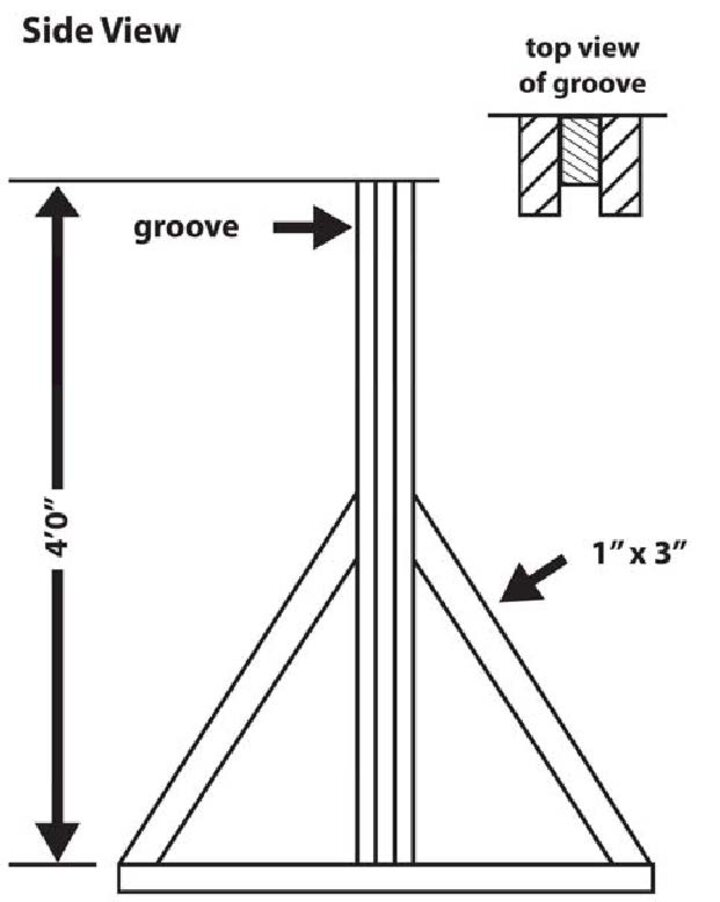
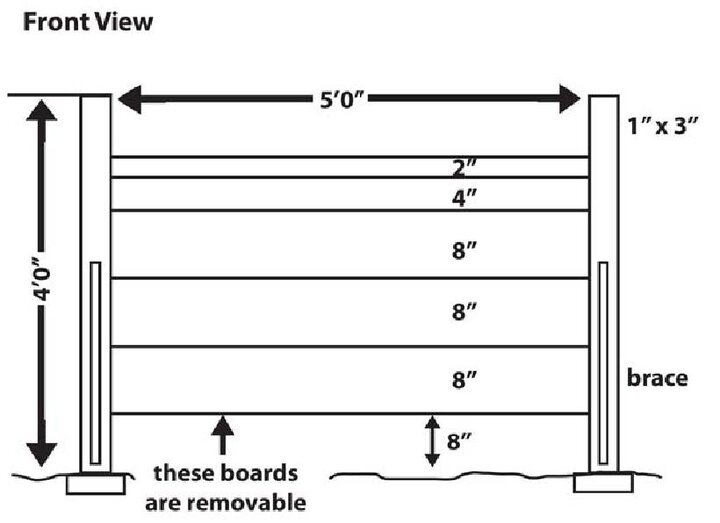
The side posts of the High Jump shall be 4 feet high, and the jump shall be 5 feet wide. It shall be constructed to provide adjustment for each 2 inches from 4 inches to 28 inches. It is suggested that the jump have a bottom board 8 inches wide, including the space from the bottom of the board to the ground or floor, plus three other 8-inch boards, one 4-inch board and one 2-inch board. A 6-inch board also may be provided. The jump shall be painted flat white. Only the width in inches shall be painted on both sides of each board in black 2-inch numbers. The number on the bottom board represents the distance from the ground or floor to the top of the board.
SUGGESTED CONSTRUCTION OF HIGH JUMP
In the Broad Jump the handler will stand with the dog sitting in the heel position in front of and anywhere at least 8 feet from the jump. On order from the judge to, “Leave your dog,” the handler will give the dog the command and/or signal to stay and go to a position facing the right side of the jump, with toes about 2 feet from the jump, anywhere between the first and last hurdle. On order from the judge, the handler shall give the command or signal to jump. The dog should then clear the entire distance of the Broad Jump without touching and, without further command or signal, return to a sitting position immediately in front of the handler as in the Recall. The handler shall change position by midair but shall remain in the same spot. On order from the judge, the handler will give the command or signal to Heel and the dog shall finish as in the Recall.
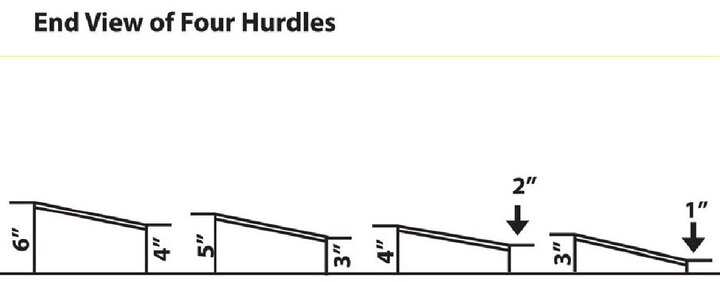
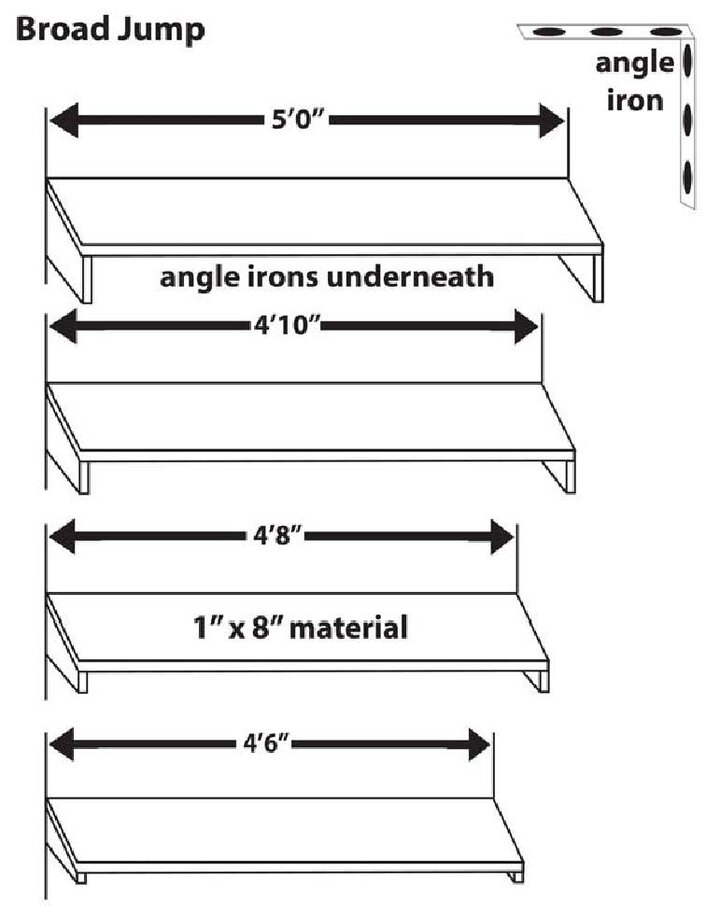
The Broad Jump shall consist of four hurdles, built to telescope for convenience. It shall be made of boards about 8 inches wide, the largest measuring about 5 feet in length and 6 inches high at the highest point. All hurdles shall be painted white.
The hurdles shall be arranged by size, evenly spaced to cover a distance equal to twice the height of the High Jump as set for the dog, with the low side of each hurdle and the lowest hurdle nearest the dog. The four hurdles shall be used for a jump of 48 inches to 72 inches, three for a jump of 28 inches to 44 inches and two for a jump of 16 inches to 24 inches. The highest hurdles shall be removed first.
SUGGESTED CONSTRUCTION OF BROAD JUMP
GRADUATE OPEN
Signal Exercise
The exercise and scoring are the same as the Utility Signal exercise except that leaving the dog will 31 be from 10 to 20 feet and the handler may give the command and/or signal on the judge’s order to stand and the judge’s signals to stay, down, sit, come, and finish.
Scent Discrimination
The exercise and scoring are the same as the Utility Scent Discrimination exercise except that only four articles (two leather, and two metal) and the handler and dog will remain facing the articles, and only one will be retrieved. It is the handler’s discretion as to which article is retrieved.
Directed Retrieve
The exercise and scoring are the same as the Utility Directed Retrieve except that no center glove is used.
Moving Stand and Examination
The exercise and scoring are the same as the Utility Moving Stand and Examination, except that the handler may pause or hesitate when giving the command and/or signal to stand.
Go Out
The principal features of this exercise are that the dog go away from the handler to the opposite end of the ring and stop as directed. The orders are: “Send your dog” and “Return to your dog.” The handler will stand in the approximate center of the ring between the jumps facing the unobstructed end of the ring. The judge will order “Send your dog,” and the handler will command and/or signal the dog to go forward at a brisk trot or gallop to a point about 20 feet past the jumps in the approximate center of the ring. When the dog reaches this point, the handler will give a command to sit. The dog must stop and sit with its attention on the handler, but it need not sit squarely. The judge will then order the handler, “Return to your dog,” and the handler will return to the heel position.
Directed Jumping
The principal features of this exercise are that the dog stay where left, jump as directed, and return to the handler as in the Novice Recall. The orders are: “Leave your dog,” “Bar,” “High” and “Finish.” The handler will stand with the dog sitting in the heel position at the unobstructed end and in the center of the ring. The judge will order “Leave your dog,” and the handler will command and/or signal the dog to stay, then walk to the far end of the ring and turn to face the dog. The judge will order either “Bar” or “High” for the jump, and the handler will command and/or signal the dog to return to the handler over that designated jump. While the dog is in midair, the handler may turn to face the dog as it returns. The dog will sit in front of the handler, and, on order from the judge, finish as in the Novice Recall. The dog will be sent over only one jump, and the same jump will be used for all dogs as designated by the judge at the start of the class.
UTILITY
Signal Exercise
The principal features of this exercise are the ability of dog and handler to work as a team while heeling, and the dog’s correct responses to the signals to Stand, Stay, Drop, Sit and Come.
Orders are the same as in Heel on Leash and Figure 8, with the additions of “Stand your dog,” which shall be given only when dog and handler are walking at normal pace, and “Leave your dog.” The judge must use signals for directing the handler to signal the dog to Drop, Sit and Come, in that sequence, and to Finish.
Heeling in this exercise shall be done in the same manner as in Heel Free, except that throughout the entire exercise the handler shall use signals only and must not speak to the dog at any time. When the judge orders “Forward,” the handler may signal the dog to walk at heel, and on separate and specific orders from the judge, shall execute a “Left Turn,” “Right Turn,” “About Turn,” “Halt,” “Slow,” “Normal” and “Fast.” These orders may be given in any sequence and may be repeated as necessary, but the judge shall attempt to standardize the heeling pattern for all dogs in the class.
On order from the judge while the dog is walking at heel, the handler shall signal the dog to Stand in the Heel position near one end of the ring. On further order “Leave your dog,” the handler shall signal the dog to Stay, go to the other side of the ring and turn to face the dog. On separate and specific signals from the judge, the handler shall give the signal to Drop, Sit, Come and Finish as in the Novice Recall. During the heeling part of this exercise, the handler may not give any signal, except when a command or signal is permitted in the heeling exercises.
Scent Discrimination
In each of these two exercises (using metal and leather-covered articles), the dog must select by scent alone and retrieve an article which has been provided and handled by its handler. These shall consist of two sets, each containing five identical articles not more than 6 inches in length. These may be items of everyday use. One set shall be made entirely of rigid metal and one of leather of such design that nothing, but leather is visible except for the minimum amount of thread or metal necessary to hold the article together. The articles in each set must be legibly numbered, each with a different number, and must be approved by the judge.
The handler shall present all 10 articles to the judge. The judge shall designate one article from each of the two sets and shall make a written note of the numbers of the two articles to be selected. These two articles shall be placed on a table or chair in the ring until picked up by the handler who shall hold only one article at a time. The handler’s scent may be imparted to the article only from the hands, which must remain in plain sight. The handler can select which article is picked up first.
Before the start of the Scent Discrimination exercises, the judge or the steward will handle each of the remaining eight articles, placing them at random in the ring about 6 inches apart. The handler will stand about 15 feet from the articles with the dog sitting in the heel position. On order from the judge, the handler will immediately place the selected article on the judge’s book or work sheet and the judge, without touching the article, will place it among other articles. The handler and dog will face away from the time the judge takes the handler’s articles until the order “Send your dog” is given.
When the judge gives the order “Send your dog,” the handler and dog will execute a Right About Turn to face the articles and the handler will simultaneously give the command or signal to retrieve. The dog shall not again sit after turning but go directly to the articles. The handler may give his or her scent to the dog by gently touching the dog’s nose with the palm of one open hand, but this may only be done while the dog is sitting at heel and the arm and hand must be returned to a natural position before handler and dog turn to face the articles. The dog shall go at a brisk pace to the articles. The dog may take any reasonable time to select the right article provided it works continuously. After picking up the right article, the dog shall return at a brisk pace and complete the exercise as in the Retrieve on the Flat. The same procedure is followed in both Scent Discrimination exercises. If a dog retrieves a wrong article in the first exercise, it shall be placed on the table or chair, and the handler’s article also must be taken from the remaining articles. The second exercise shall then be completed with one less article in the ring.
Directed Retrieve
The Directed Retrieve exercise has three principal features: 1) the dog must stay until directed to retrieve; 2) following a command, the dog must go directly to the designated glove; and 3) the dog should retrieve promptly. The orders for the exercise are “One,” “Two” or “Three,” followed by “Take it’ and “Finish.” In this exercise, the handler will provide three predominantly white, cotton work gloves, which must be open and approved by the judge. The handler will stand with his or her back to the unobstructed end of the ring with the dog sitting in the Heel position midway between and in line with the two jumps. The judge or steward will then drop the three gloves across the end of the ring, one glove in each corner and one in the center, about 3 feet from the side of the ring, while the handler and dog are facing the opposite direction. All three gloves should be clearly visible to the dog and handler when the team turns to face the glove designated by the judge. There shall be no table or chair at this end of the ring.
The gloves shall be designated “One, Two and Three” reading from left to right when the handler turns and faces the gloves. The judge will give the order, “One, Two, or Three”. The handler then must give the command to Heel and turn in place, right or left, to face the designated glove. The handler will then give the dog the direction to the designated glove with a single motion of the left hand and arm along the right side of the dog and will give the command to retrieve either simultaneously with or immediately following giving the direction. The dog shall then go directly to the glove at a brisk pace and retrieve it without unnecessary mouthing or playing with it, completing the exercise as in the Retrieve on the Flat.
The handler may bend his or her knees and body in giving the direction to the dog, after which the handler will stand erect in a natural position with arms at his or her sides.
The exercise shall consist of a single retrieve, but the judge shall designate different glove numbers for successive dogs.
Moving Stand and Examination
The principal features of the exercise are that the dog heel, stand and stay on command by the moving handler, accept the examination without shyness or resentment and, on command, return to the handler.
The first two orders for the exercise, “Forward” and “Stand your Dog,” are to be given while the handler is walking, followed by “Call your dog to heel.”
The handler stands with his dog sitting in the heel position at a point indicated by the judge. The judge asks, “Are you ready?” and orders “Forward.” The handler commands or signals his or her dog to heel and walks briskly at a normal pace. After the handler has proceeded about 10 feet, the judge orders, “Stand your dog.” The handler will, without pausing, command and/or signal the dog to stand, continue forward 10 to 12 feet and turn around, either to the right or left, and stand facing the dog. The dog must stand and stay in position.
Go Out
The principal features of this exercise are that the dog goes away from the handler to the opposite end of the ring and stop as directed. The orders are: “Send your dog” and “Return to your dog.” The handler will stand in the approximate center of the ring between the jumps facing the unobstructed end of the ring. The judge will order “Send your dog,” and the handler will command and/or signal the dog to go forward at a brisk trot or gallop to a point about 20 feet past the jumps in the approximate center of the ring. When the dog reaches this point, the handler will give a command to sit. The dog must stop and sit with its attention on the handler, but it need not sit squarely. The judge will then order the handler, “Return to your dog,” and the handler will return to the heel position.
Directed Jumping
The principal features of this exercise are as follows: the dog goes away from the handler in the direction indicated, stops, jumps as directed and returns as in the Recall.
The orders are “Send your dog,” the designation of the jump to be taken and “Finish.”
The jumps shall be placed midway in the ring at right angles to the sides of the ring, 18 to 20 feet apart, the Bar Jump on one side, the High Jump on the other. The judge must make certain the jumps are set at the required height for each dog by following the procedure described in Retrieve over the High Jump.
The handler, from a position on the ring’s center line and about 20 feet from the line of the jumps, shall stand with the dog sitting in the Heel position and, on order from the judge, shall command and/or signal the dog to go forward at a brisk pace to a point about 20 feet beyond the jumps and the approximate center.
When the dog has reached this point, the handler shall give a command to Sit. The dog must stop and sit with attention on the handler but does not need to sit squarely.
The judge will designate which jump is to be taken first by the dog, and the handler shall command and/or signal the dog to return over the designated jump. While the dog is in midair the handler may turn to face the dog as it returns. The dog shall sit in front of the handler and, on order from the judge, finish as in the Recall. The judge will say, “Exercise finished” after the dog has returned to the Heel position.
When the dog is again sitting in the Heel position, the judge shall ask, “Are you ready?” before giving the order to send the dog for the second part of the exercise. The same procedure shall be followed for the second jump.
The judge may decide which jump is taken first, but both jumps must be taken to complete the exercise. The judge must not designate the jump until the dog is at the far end of the ring. The dog shall clear the jumps without touching them.
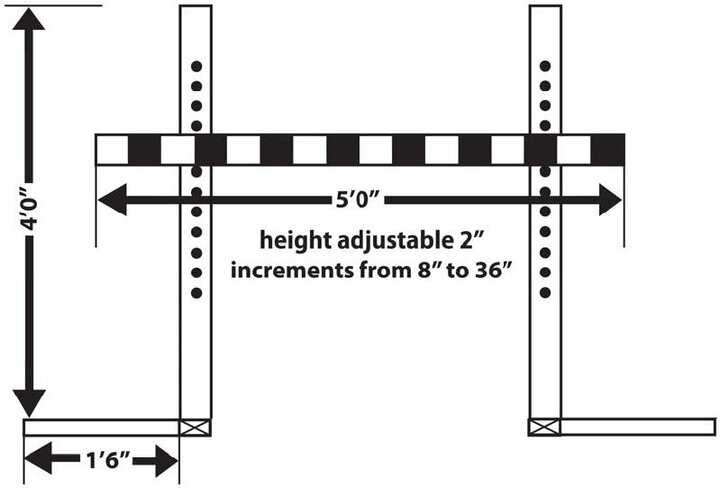
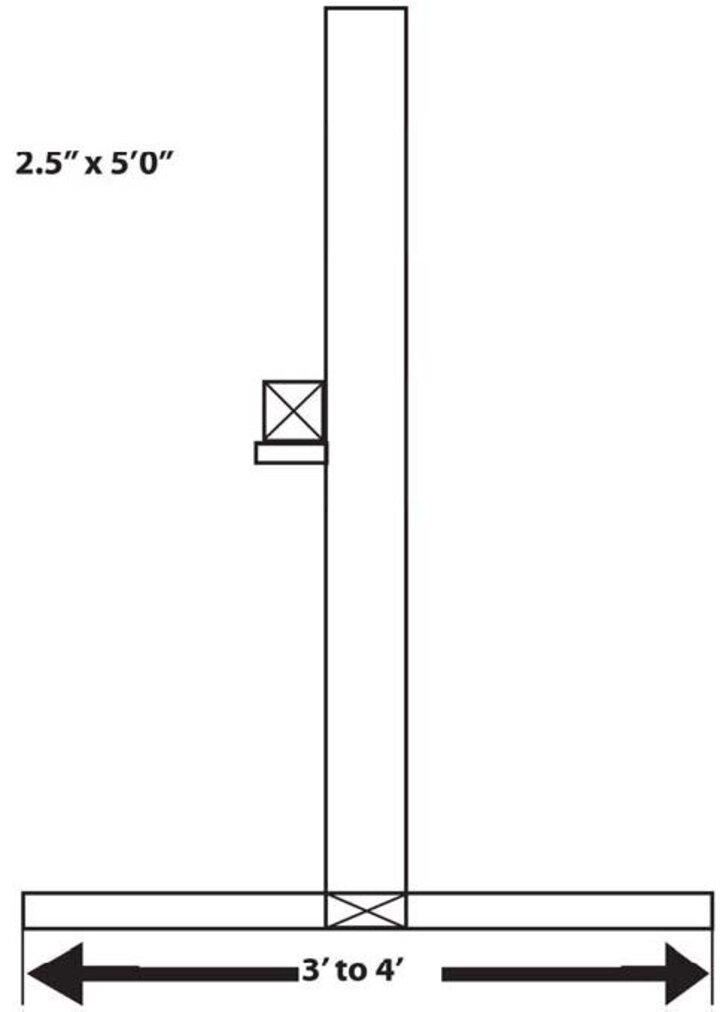
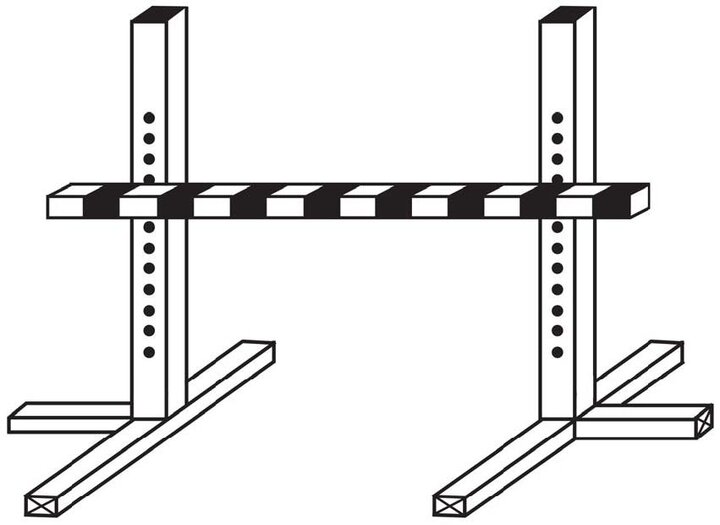
The height of the jumps shall be the same as required in the open classes. The High Jump shall be the same as that used in the open classes, and the Bar Jump shall consist of a bar between 2 and 2- 1/2 inches square with four edges rounded sufficiently to remove sharpness. The bar shall be painted a flat black and white in alternate sections of about 3 inches each. The bar shall be adjustable for each 2 inches of height from 8 inches to 36 inches. The jump shall be constructed and positioned so the bar can be knocked off without disturbing the uprights.
SUGGESTED CONSTRUCTION OF BAR JUMP